A free birth chart calculator can reveal far more than a daily horoscope or a single zodiac sign. In astrology, your birth chart—also called a natal chart—is a symbolic map of the sky for the date, time, and location of your birth. It brings together the Sun, Moon, planets, zodiac signs, astrological houses, and planetary aspects to create a more detailed picture than your Sun sign alone.
At Next Astrology, you can use this guide to understand what a natal chart contains, what information you need to calculate one, and how to begin interpreting the result. Whether you are completely new to astrology or already know your Sun sign, learning the basics can help you explore the chart in a clear, organized way. Astrology is best approached as a reflective and symbolic system—not as a scientific personality test or a fixed prediction of your future.
What Is a Birth Chart in Astrology?
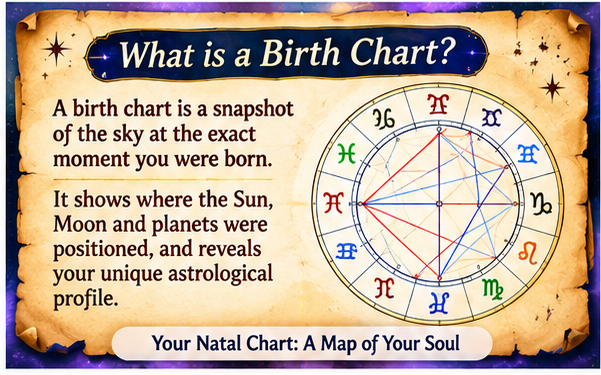
A birth chart, also known as a natal chart, is a diagram showing the positions of the Sun, Moon, and planets at a particular moment and place. An astrologer uses your birth date, birth time, and birthplace to calculate the chart. The result is usually displayed as a circular wheel divided into twelve zodiac signs and twelve houses, with symbols showing where the celestial bodies were located.
Each part of the chart has a different role in traditional astrological interpretation:
- Planets and luminaries represent different drives or areas of human experience, such as identity, emotion, communication, affection, motivation, and responsibility.
- Zodiac signs describe the style or qualities associated with each planet’s placement.
- Astrological houses connect placements with life themes such as identity, money, communication, home, creativity, relationships, work, and beliefs.
- Aspects are angular relationships between planets. Astrologers interpret them as patterns of ease, tension, or interaction.
These elements are read together. For example, knowing that someone has a particular Moon sign is only one part of the picture. Its house placement and aspects may add further layers to the traditional interpretation.
What Information Do You Need to Calculate a Free Birth Chart?
Most natal chart calculators ask for three essential details. Enter them as accurately as possible because small differences—especially in birth time—can affect parts of the chart.
1. Your date of birth
Your birth date helps determine the zodiac positions for that day. It is used to calculate the Sun’s position and the placements of the Moon and planets. If you were born close to a sign change, the exact date and time can matter when identifying a placement.
2. Your exact birth time
Birth time is especially important for calculating the Ascendant, also called the rising sign, and the house cusps. The Earth rotates continuously, so the eastern horizon changes over the course of the day. A time that is several minutes or hours off may change the Ascendant degree and, in some cases, the rising sign or house placements.
If you do not know your exact birth time, check a birth certificate or ask a family member who may remember. If the time cannot be confirmed, use a chart calculator that allows an unknown or approximate time, and treat the Ascendant and houses as uncertain. Do not assume a noon chart gives an accurate rising sign.
3. Your birthplace
The city and country where you were born help determine the local horizon and the correct time-zone information for the chart. Choose the actual birthplace rather than your current home. If a calculator offers a list of matching locations, select the correct city and country.
The Big Three: Sun Sign, Moon Sign, and Rising Sign
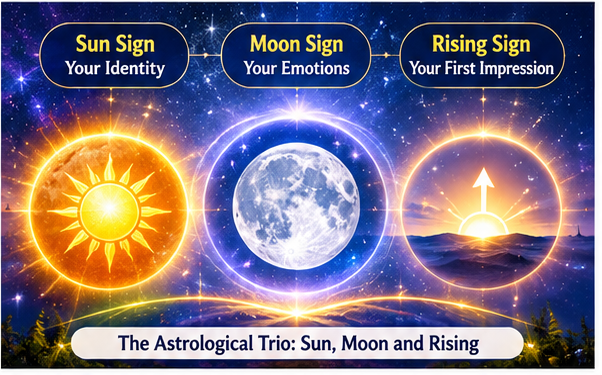
Astrology beginners often start with the Big Three: the Sun, Moon, and Ascendant. These placements are popular because they provide three different starting points for exploring a natal chart.
Sun sign: identity and self-expression
The Sun is traditionally associated with identity, vitality, purpose, and conscious self-expression. Your Sun sign is the zodiac sign most people mean when they ask, “What’s your sign?” It can be a useful introduction, but it does not describe the whole chart or every aspect of a person’s personality.
Moon sign: feelings and emotional needs
The Moon is associated in astrology with emotions, instincts, habits, and the need for comfort and security. Your Moon sign offers a symbolic way to explore how you respond emotionally and what may help you feel supported. Because the Moon moves relatively quickly through the zodiac, birth time and location can be important, particularly when it is near a sign boundary.
Rising sign: approach and first impressions
Your rising sign, or Ascendant, is the zodiac sign rising on the eastern horizon at the moment of birth. Astrologers associate it with first impressions, outward approach, and the way a person enters unfamiliar situations. It also anchors the chart’s house structure in many common chart systems.
Think of the Big Three as a starting framework rather than three labels that explain everything. The rest of the chart adds context and nuance.
What Is a Rising Sign, and Why Does Birth Time Matter?
The Ascendant is calculated from the local horizon at your birth moment. Since the horizon changes as Earth rotates, the rising sign typically changes during the day. This is why a birth chart calculator needs a reasonably accurate time to calculate it.
Astrologers often describe the Ascendant as the chart’s point of entry: it helps set the order of the houses and is traditionally connected with appearance, manner, and immediate responses. Its ruling planet—sometimes called the chart ruler—is also considered important in many styles of chart interpretation.
If your birth time is unknown, you can still explore some planetary sign placements, but you should not treat the calculated rising sign or house positions as reliable. Be transparent about uncertainty rather than relying on a guessed time.
Understanding the 12 Astrological Houses
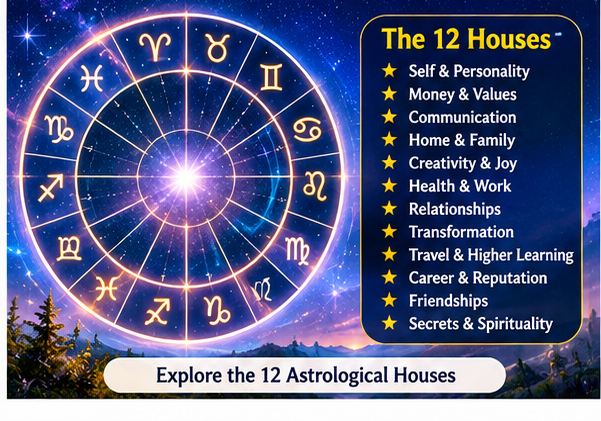
The twelve houses divide a natal chart into areas of life. The signs and planets describe symbolic qualities and functions, while houses show where astrologers look for those themes. House meanings can vary somewhat between astrological traditions, but a common beginner overview is:
- First House: identity, self-presentation, and beginnings.
- Second House: personal resources, possessions, values, and income.
- Third House: communication, learning, siblings, and everyday surroundings.
- Fourth House: home, family, roots, and private life.
- Fifth House: creativity, pleasure, romance, and self-expression.
- Sixth House: routines, work habits, service, and daily wellbeing.
- Seventh House: partnerships, committed relationships, and one-to-one connections.
- Eighth House: shared resources, intimacy, transformation, and psychological depth.
- Ninth House: higher education, philosophy, travel, and belief systems.
- Tenth House: career, public role, reputation, and long-term ambitions.
- Eleventh House: friendships, groups, networks, and collective goals.
- Twelfth House: solitude, reflection, hidden matters, and spiritual themes.
A planet’s house placement is not a guaranteed event or outcome. It is one symbolic factor that astrologers consider alongside the sign, aspects, chart ruler, and the chart as a whole.
Planets in a Natal Chart: What Do They Represent?
Many modern Western birth charts include the Sun, Moon, Mercury, Venus, Mars, Jupiter, Saturn, Uranus, Neptune, and Pluto. The Sun and Moon are technically luminaries, but they are commonly discussed with the planets in chart readings.
- Sun: identity, vitality, and conscious purpose.
- Moon: emotional patterns, instincts, and comfort.
- Mercury: thinking, learning, and communication.
- Venus: affection, attraction, values, and pleasure.
- Mars: drive, initiative, energy, and conflict style.
- Jupiter: growth, opportunity, learning, and belief.
- Saturn: structure, responsibility, boundaries, and discipline.
- Uranus: change, independence, originality, and disruption.
- Neptune: imagination, ideals, dreams, and uncertainty.
- Pluto: power, deep change, and transformation.
Interpretations differ between schools of astrology. A useful reading avoids judging a placement as simply good or bad and instead considers how its themes may be expressed in different circumstances.
What Are Planetary Aspects?
Aspects are the angles formed between planets in a chart. They are often shown as colored lines inside the chart wheel. Astrologers use aspects to explore how different planetary themes may interact.
- Conjunction: two placements are close together, blending their symbolism.
- Sextile: an angle traditionally associated with cooperation and opportunity.
- Square: a challenging angle often interpreted as friction that can prompt action.
- Trine: an angle commonly associated with ease, flow, or natural support.
- Opposition: placements face one another, often interpreted through contrast, balance, or relationship dynamics.
The exact degree and the orb—the allowed distance from an exact angle—matter in many chart systems. A single aspect should not be interpreted in isolation. Consider the planets involved, their signs and houses, and the wider pattern of the chart.
How to Read Your Birth Chart Step by Step
A chart can look complicated when you first open it. Rather than trying to interpret every symbol at once, use a simple sequence:
- Check your birth data. Confirm the date, time, and birthplace used by the calculator. Correct data is the foundation of the chart.
- Find your Big Three. Identify your Sun, Moon, and rising sign. Note which parts of the chart depend on an exact birth time.
- Review personal planets. Start with Mercury, Venus, and Mars to explore traditional themes of communication, affection, values, action, and motivation.
- Look at the houses. Notice which life areas contain several planets and which houses are emphasized.
- Explore major aspects. Begin with conjunctions, squares, trines, oppositions, and sextiles. Look for repeated themes rather than treating one line as the whole story.
- Put the pieces together. Ask how the sign, house, and aspects modify one another. A balanced interpretation considers the whole chart.
- Use reflection, not labels. Compare the symbolism with your own experience, but do not let a chart define your worth, limit your choices, or replace professional advice.
For a more detailed walkthrough, read our guide: Birth Chart Calculator: How to Read Your Natal Chart Step by Step.
Birth Chart vs. Horoscope: What Is the Difference?
A natal chart is calculated for the moment and place of birth, so its basic planetary placements remain the same. A horoscope usually refers to an interpretation based on current or upcoming planetary positions. Newspaper-style Sun-sign horoscopes are broad; a transit reading may compare current planetary positions with a person’s natal chart.
In short, a birth chart is the natal reference map, while a horoscope describes an interpretation for a particular period. Neither should be treated as a guaranteed forecast.
Birth Chart Compatibility: How Does Synastry Work?
When astrologers compare two people’s natal charts, the technique is commonly called synastry. It examines the relationships between placements in one chart and placements in the other. Practitioners may consider the Moon, Venus, Mars, Mercury, the Sun, the Ascendant, and connections involving the relationship houses.
Synastry is not a scientific test of whether two people should be together. It is a symbolic framework some people use to discuss differences, communication, affection, and expectations. Real relationships depend on choices, respect, communication, shared values, and circumstances—not planetary placements alone.
Learn more in our related article: Synastry Chart Calculator: How to Compare Two Birth Charts.
Can a Birth Chart Explain Love and Relationships?
In traditional astrology, Venus is often associated with affection and values, Mars with desire and initiative, and the Moon with emotional needs. The seventh house is commonly examined for partnership themes, while the fifth house is associated with romance and enjoyment. These are interpretive conventions, not rules that determine someone’s romantic future.
If you are exploring relationship themes, you may also find our guide to the Love Counter: What a Love Percentage Means and How to Use It useful. Remember that a compatibility percentage or chart comparison is best treated as entertainment or a conversation starter, not a measure of a relationship’s real value.
Common Birth Chart Mistakes to Avoid
- Using an inaccurate birth time: this can make the Ascendant and houses unreliable.
- Reading only the Sun sign: a natal chart contains many placements and patterns.
- Taking one placement literally: chart factors are traditionally interpreted in context, not as isolated verdicts.
- Assuming astrology predicts fixed events: symbolic interpretations do not guarantee what will happen.
- Confusing a natal chart with a daily horoscope: one is based on birth data; the other generally concerns a particular period.
- Sharing birth details carelessly: birth date, time, and birthplace are personal information. Use reputable services and check their privacy practices before submitting details.
Is Astrology Scientific?
Astrology has a long cultural and historical tradition, and many people use it for reflection, storytelling, or spiritual practice. However, astrological claims about personality and prediction have not been established as scientific facts. A birth chart should not be used as a substitute for medical, mental-health, financial, legal, or other professional guidance.
You can still explore astrology as a symbolic language while keeping a critical perspective. Treat interpretations as prompts for thought rather than objective diagnoses or instructions.
Frequently Asked Questions About Free Birth Charts
Can I calculate my birth chart for free?
Yes. Many online natal chart calculators provide basic chart calculations at no cost. Check what the tool includes, whether it requires registration, and how it handles your personal birth information.
What if I don’t know my birth time?
You can still explore some planetary placements, but the Ascendant and houses may be inaccurate or unavailable. Avoid relying on a guessed time for precise house or rising-sign interpretations.
Is my birth chart the same as my zodiac sign?
No. Your common zodiac sign usually refers to your Sun sign. A full birth chart includes the Moon, planets, houses, and aspects, offering a more layered astrological interpretation.
Does my birth chart change over time?
Your natal chart is calculated for your birth moment and does not change. Astrologers may compare it with current planetary movements or use other techniques to discuss different periods.
How accurate is a birth chart calculator?
The calculation depends on correct birth details, reliable time-zone and location data, and the chart system used. The mathematical chart positions can be calculated, but the meaning assigned to them is an astrological interpretation rather than a scientifically verified personality assessment.
What is the difference between a natal chart and a birth horoscope?
The terms are sometimes used interchangeably. Usually, natal chart refers to the full chart calculated for birth, while horoscope can mean an interpretation of that chart or a forecast for a particular time. Check how a website uses the terms.
Can two people have the same birth chart?
People born at nearly the same time and place can have very similar charts, though exact location, time, and chart settings may produce differences. A chart is not a scientifically unique identity marker.
Can my birth chart tell me my future?
Astrology offers symbolic interpretations, but it cannot reliably guarantee specific future events. Your decisions, relationships, opportunities, and circumstances matter in shaping your life.
Explore Your Natal Chart with Next Astrology
Your birth chart is a starting point for exploring the many symbols used in astrology. Begin with the Sun, Moon, and Ascendant, then learn how planets, houses, and aspects add context. Take your time, verify your birth details, and focus on the themes that encourage thoughtful self-reflection.
Continue learning with our complete birth chart reading guide, explore how two charts are compared in our synastry guide, or read about relationship scoring in our Love Counter guide. Next Astrology aims to make astrology topics easier to understand while encouraging readers to think critically and make their own choices.